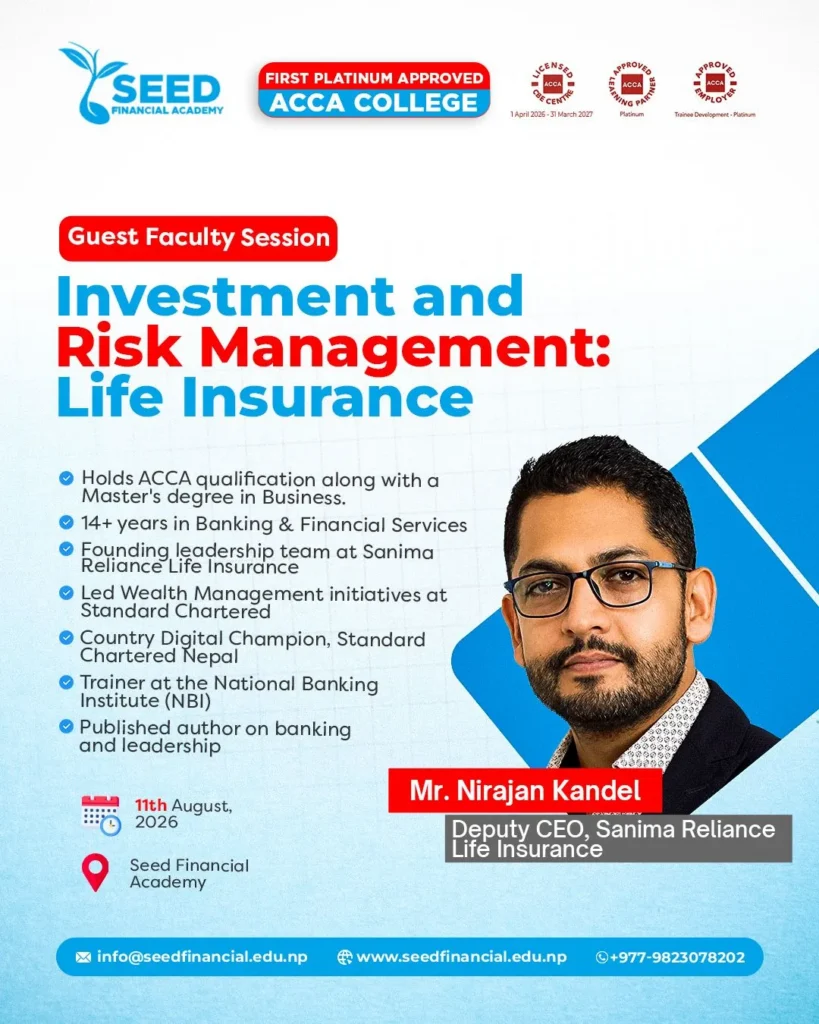
Guest Faculty Session | 11 August 2026 | Seed Financial Academy
About the speaker
Mr. Nirajan Kandel is Deputy CEO of Sanima Reliance Life Insurance and a member of the company’s founding leadership team. He holds an ACCA qualification and a Master’s degree in Business, with more than 14 years of experience in banking and financial services.
He previously led wealth management initiatives at Standard Chartered and served as the Country Digital Champion for Standard Chartered Nepal. He is also a trainer at the National Banking Institute (NBI) and a published author on banking and leadership.
A customer pays Rs 100,000 in premium today. The company may not have to pay the benefit for another 15 or 20 years. So, what happens to that money in the meantime?
That simple question opened a guest faculty session at Seed Financial Academy on 11 August 2026, led by Mr. Nirajan Kandel, Deputy CEO of Sanima Reliance Life Insurance.
Throughout the session, students explored the answer and gained a better understanding of how life insurance companies invest their funds and how those investments connect to Nepal’s wider financial system.
Two engines, not one
Mr. Kandel began by addressing a common misunderstanding about life insurance. Students often think of life insurance mainly in terms of selling policies and paying claims. In reality, he explained, a life insurer operates through two key functions: an insurance engine and an investment engine.
The insurance side focuses on selling suitable policies, assessing risk and managing claims. The investment side focuses on putting the accumulated funds to work, generating sustainable returns and ensuring there is enough liquidity when the money is needed.
He also pointed out that strong premium growth alone does not necessarily mean that an insurance company is performing well. In a savings-linked market like Nepal, investment income plays an important role in fulfilling the promises made to policyholders, including the bonuses that customers and agents are particularly interested in.
Mr. Kandel also made it clear that premium is not the same as profit. Claims, operating expenses, agent commissions, and actuarial liabilities must be accounted for first. The funds that remain and accumulate over many years across different policies form the investment pool.
The five questions
One of the most practical parts of the session was a simple framework built around five questions. According to Mr. Kandel, every investment proposal needs to answer these questions before it can move forward:
- Safety -Can we recover the principal?
- Return – Is the return adequate for the risk involved?
- Liquidity -Can we access the money when we need it?
- Duration -Does the investment period match our liabilities?
- Diversification -Are we relying too heavily on one investment or name?
To put this framework into practice, Mr. Kandel presented the class with a hotel project offering an attractive headline return. The project would take years to complete, would not generate cash flow in its early stages, could not be sold quickly, and depended heavily on tourism demand. The business itself could be a good one, but that does not automatically make it a suitable investment for an insurer that may need funds to pay claims the following month.
This highlighted an important difference: when an individual invests their own money, they bear the consequences of the decision themselves. A life insurer, however, is investing money that supports its promises to thousands of policyholders.
Inside Nepal’s regulatory framework
The discussion then moved to the Nepal Insurance Authority’s Investment Directive, issued under the Insurance Act, 2079. Mr. Kandel explained three terms that can often be confused in both exams and professional practice: minimum, maximum and permitted.
He also discussed some of the key investment limits, including a minimum of 25 percent in government securities, at least 30 percent in fixed deposits with Class A banks and infrastructure development banks, and a maximum of 15 percent in listed shares.
He explained that safer assets generally offer greater security but may provide lower returns. This creates a trade-off that insurers have to manage carefully. It is part of how the business is structured rather than simply a sign of poor management.
Students were also introduced to the limits on insurance investments in productive sectors such as hydropower, tourism, education, health, renewable energy and transport. These sectors are capped at 10 percent combined and 5 percent in any single project, with investments also subject to conditions such as feasibility studies and independent external assessment.
Alternative investments such as private equity and venture capital have much smaller limits. Mr. Kandel explained that this is because these investments can be less liquid, more difficult to value, and slower to return capital.
One important point came up more than once during the discussion: just because an investment is allowed does not mean it is necessarily suitable. A proposal may fall within all regulatory limits and still be a poor investment decision.
From household savings to national capital
The session also looked at the size of the life insurance sector’s investment pool in Nepal. At the end of FY 2081/82, it stood at roughly Rs 759.66 billion, representing an increase of about 17 percent from the previous year.
Mr. Kandel asked students to think about where this money actually comes from. It does not come only from a small group of wealthy investors. It comes from teachers, shopkeepers, migrant workers and salaried families who pay their insurance premiums month after month.
When these funds move through the economy, they can support government spending through securities, business lending through bank deposits, and longer-term investments in areas such as energy, transport, education and health. Eventually, the returns generated from these investments help fund the maturity benefits paid to policyholders.
At the same time, Mr. Kandel stressed that an insurance company is not a charity or a development agency. An investment may have national importance, but that does not automatically make it a good investment. If an insurer makes poor investment decisions in the name of development, it can ultimately hurt the very policyholders it is expected to protect.
Risk as a chain, not a checklist
The session also looked at risk management from a different perspective. Mr. Kandel explained that risk is not simply about losing money. It is the possibility that actual events may turn out differently from what was expected, affecting the company’s ability to meet its commitments.
He demonstrated this using an example connected to Nepal’s changing interest rate environment. When deposit rates fall, new investments may generate lower returns. As a result, the overall yield can decline. At the same time, bonus expectations may come under pressure while customers and agents continue to expect similar benefits. This can encourage management to look for investments offering higher returns. However, those investments may also carry greater credit, market, and liquidity risks.
The key lesson was that risks are connected. Managing risk is not simply about making a list of possible problems. It is about understanding how one risk can lead to another and taking action before the situation gets worse.
Mr. Kandel also introduced students to asset-liability management through an example they could easily relate to. A family might own land worth a crore and still struggle to pay a hospital bill on Friday because the value of the land cannot immediately be converted into cash.
The lesson is simple: wealth is not the same as liquidity.
Careers ACCA students may not have considered
For Seed’s ACCA students, one section of the session was particularly of great concern. Mr. Kandel explained the different roles qualified finance professionals can take on within a life insurance company. These include financial analysis, investment appraisal, audit and assurance, internal control, risk assessment, regulatory compliance, management reporting and governance.
He also pointed out that the investment committee papers used to make decisions on the deployment of hundreds of billions of rupees are prepared by professionals whose work draws on many of the skills covered in the ACCA syllabus.
A career in insurance, therefore, is not limited to sales.
You are the investment committee
The session ended with a group exercise that gave students an opportunity to apply what they had learned. The teams took on the role of an investment committee and were asked to allocate Rs 100 across the different permitted asset classes. They had to stay within the NIA limits while explaining their expected return, key risks, and plan for meeting future cash requirements. The mistakes made during the exercise became useful learning points.
Groups that allocated a large share to shares and projects were asked how they would meet the following month’s claims. Those that placed almost everything in government securities and deposits were asked where the returns needed to support bonuses would come from.
Mr. Kandel’s conclusion was straightforward: there is no perfect portfolio. There is only a balance that you can explain and defend. He ended with an open question for the students: if you were responsible for other people’s money, what would matter most to you -safety, return, liquidity, or trust? The answer, he suggested, is not just one of these factors. A strong life insurer needs to manage all four, while trust is built when the other three are handled well.
Seed Financial Academy is Nepal’s first Platinum Approved ACCA College, a Licensed ACCA CBE Centre and an ACCA Approved Employer (Trainee Development – Platinum).
Its guest faculty series brings senior industry practitioners into the classroom, helping students connect what they learn in their syllabus with the decisions being made across Nepal’s financial sector.
For information on upcoming sessions and programmes:
info@seedfinancial.edu.np | Seed Financial Academy | +977-9823078202