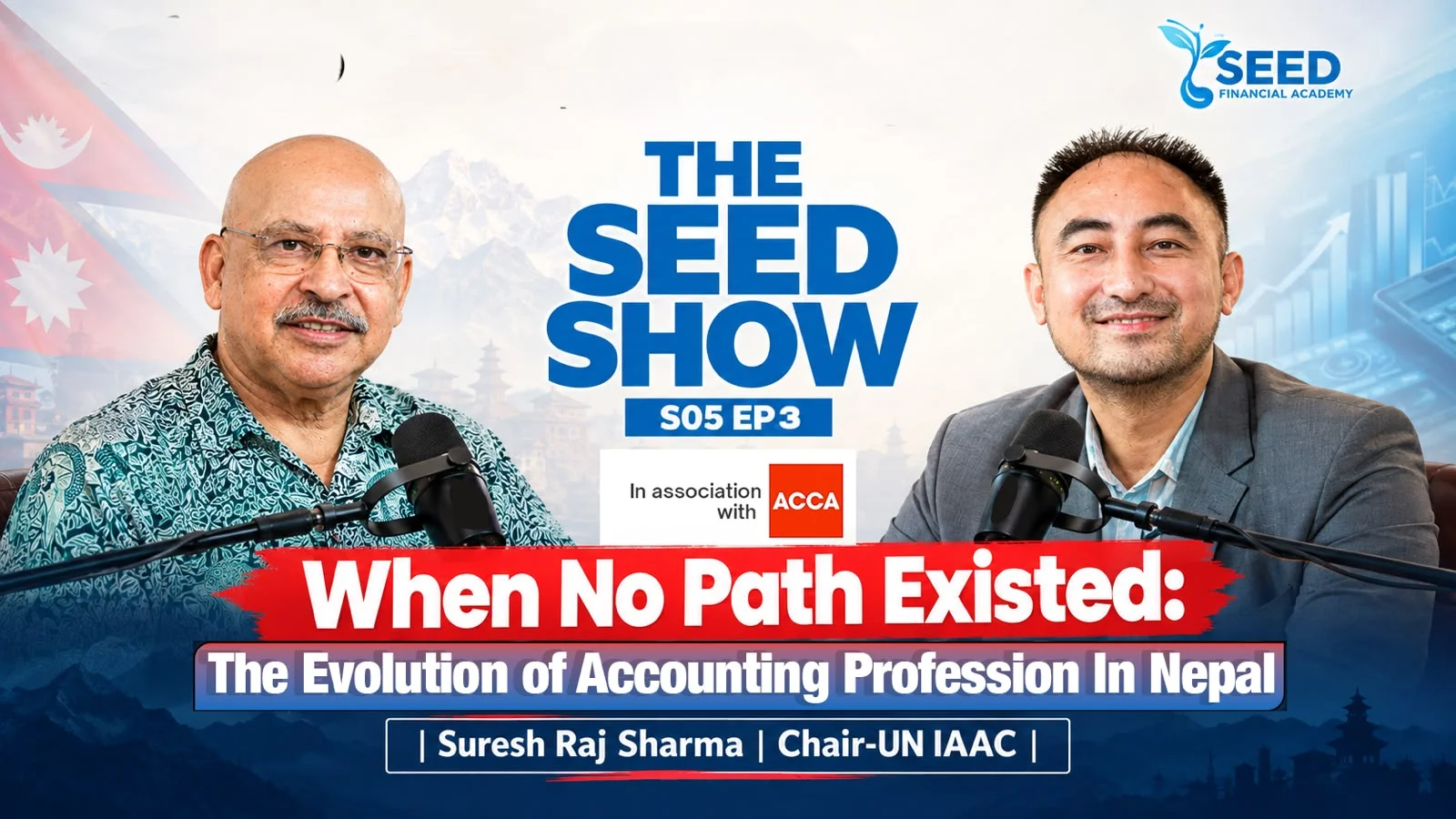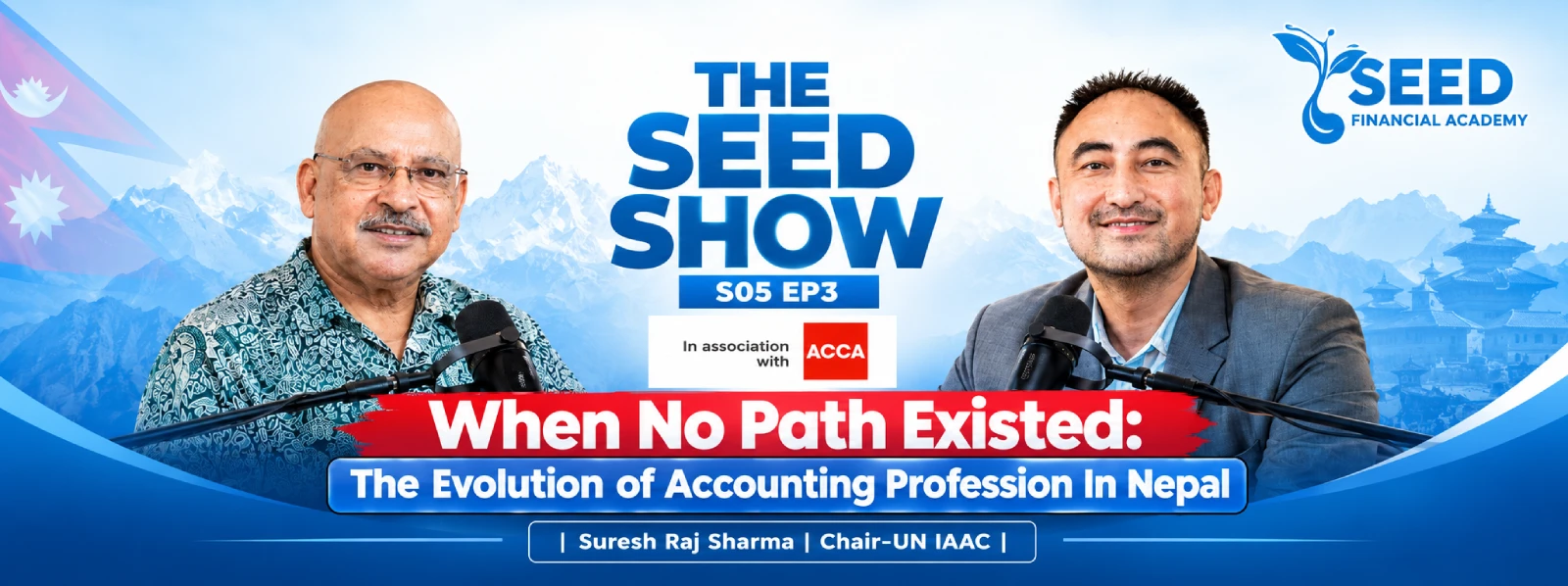

The Seed Show, Season 5, Episode 3 | Guest: Mr. Suresh Raj Sharma | Host: Sanjay Pradhan, FCCA
Season 5 of The Seed Show, produced in association with ACCA, brings together voices from different sectors of the economy. After episodes on banking and hospitality, Episode 3 focuses on the not-for-profit sector. The guest is one of the most distinguished professionals to appear on the show: Mr. Suresh Raj Sharma, Nepal’s first ACCA member and now Chair of the United Nations Independent Audit Advisory Committee (IAAC).
Over nearly five decades, Mr. Sharma’s career has taken him from a small accounting office in Kathmandu to a senior role advising the UN General Assembly on audit and oversight. Host Sanjay Pradhan described him as “a father figure of the accountancy profession in Nepal.”
A career that began outside a classroom
Mr. Sharma had planned to study science after his SLC. However, his name did not appear on the first admission list. His friends then encouraged him to consider commerce. One day, while walking past a classroom, he heard the late Sundar Man Shrestha explaining the golden rules of accounting: debit what comes in, credit what goes out.
“It attracted me so much that I decided to study commerce,” he recalled.
Later, his teacher left for India to study chartered accountancy. This made the 18-year-old Sharma think about becoming a chartered accountant himself.
“A CA must be something even bigger than a professor. One day, I must do it too,” he recalled.
Becoming Nepal’s first ACCA member
In the early 1970s, Nepal did not have an accounting institute. Studying in India was also difficult because Mr. Sharma was working full-time. Following the advice of Dorothy Thibrum, an ACCA member and internal auditor at the United Mission to Nepal (UMN), he contacted ACCA.
The first reply said that an ACCA exam centre could not be established in Nepal. Mr. Sharma did not give up. He explained that Nepal was a separate country without its own accounting institute. ACCA eventually agreed to hold the exams at the British Council in Kathmandu.
He studied through correspondence with Rapid Results College, receiving study materials by post and sending his completed test papers back to the college. For his first exam, he was the only candidate in the room. A British Council invigilator sat at the front while he took the exam.
After studying from 1973 to 1977, he became an ACCA member in 1977. He was the first Nepali to hold ACCA membership, followed shortly afterwards by Umed Singh Jain.
He also had a clear message for today’s members: “The value of this qualification is continued membership. Passing an exam once doesn’t make you qualified forever. Integrity, ethics and independence must continue.” He pointed out that passing the ACCA exams is not the end of the journey. Members must maintain their membership to continue using the ACCA designation.
Accounting before computers
For people who have only worked with digital accounting systems, Mr. Sharma described a very different time. Accounts were maintained by hand using vouchers, journals and ledgers.
At United Mission to Nepal (UMN), he updated individual provident fund records for 500 to 600 staff every month. Each entry had to be recorded by hand. A small innovation made the work easier. A German stationery board with carbon paper allowed one entry to be recorded in the journal and ledger at the same time. This cut the work in half. Trial balances were also totalled by hand. Calculators were mainly printing machines or abacus-style devices. Mr. Sharma did not see a computer until he went abroad.
From budget analyst to Inspector General
After working at UMN and the Agriculture Inputs Corporation, Mr. Sharma joined Tribhuvan University. There, he became Chief Finance Officer at a special-class level. He later worked at Southern Illinois University in the United States before joining the World Food Programme (WFP) in Rome in 1989.
He started at WFP as a budget analyst, which he described as an entry-level role. His guiding principle was simple: “Always do more than what is expected of you.” One analysis he prepared reached WFP’s Executive Director. This led to opportunities to work directly with senior leadership. In 1995, he made major changes to WFP’s financial policy. He still considers this one of the reasons WFP operates more effectively than many other UN bodies.
He later became Country Director in Sri Lanka, where he took groups of ambassadors to WFP project sites and served them meals prepared using the food rations provided through WFP programmes.
He then became Director of Finance and later Director of Change Management. He also set up WFP’s Ethics Office. Eventually, he served as Inspector General and Director of Oversight.
Chairing the UN’s Independent Audit Advisory Committee
Mr. Sharma explained how the IAAC was created. The decision came after the Volcker Commission investigated the Oil-for-Food Programme and found that the UN’s internal audit function had not done its job well.
The General Assembly then created an independent body to oversee the internal audit function. The committee has five members. They are nominated from five regions and elected by member states. Mr. Sharma represents the Asia-Pacific region and has chaired the committee since January 2026.
The committee meets four times a year to review whether the Office of Internal Oversight Services (OIOS) is assessing risks properly and covering high-risk areas. It also checks whether audit recommendations are being implemented.
The committee recommends the OIOS budget before it goes to the General Assembly for approval. It also coordinates with the Board of Auditors and the Joint Inspection Unit. Mr. Sharma also chairs the network of oversight committees across the UN system.
Independence, ethics and courage
Independence was one of the main themes of the conversation. Sanjay Pradhan pointed out that failures in Nepali institutions rarely happen overnight and said that a lack of independence within audit committees is often part of the problem.
Mr. Sharma agreed and suggested a practical step. He said audit committees could include external practitioners who are not part of the board, allowing them to provide independent views.
However, Mr. Sharma said the deeper issue was ethics.
“The core issue is a lack of ethics,” he said.
He explained that senior people need the integrity not to pressure others, while those in junior positions need the courage to refuse inappropriate instructions.
He also said that responsibility increases with seniority. Although conflicts of interest are recognised in policies and rules, they are not always properly addressed in practice.
Should Nepal separate its audit regulator?
Mr. Sharma was direct when discussing the regulation of the profession in Nepal. He said that because ICAN acts as both an educator and a regulator, there is a conflict of interest.
He said even if ICAN has rules to separate its educational and regulatory functions, people may still question its independence because both functions are under the same organisation.
He suggested giving audit regulation to the Office of the Auditor General as an interim measure. In the long term, he suggested creating a separate and independent audit regulatory body. He believed this would strengthen Nepal’s credibility internationally.
Equivalence and mutual recognition
Mr. Sharma also discussed the long-running debate over whether professional qualifications such as ACCA should be considered equivalent to academic degrees. He explained that these are different types of qualifications and should not simply be compared with one another. Instead, he suggested that an independent regulatory body should decide how professional qualifications are recognised.
He also discussed the ACCA–ICAN arrangement in Nepal. In his view, ACCA members who want their qualification recognised in Nepal should only need to meet requirements related to areas they may not have studied as part of their ACCA qualification, particularly subjects specific to Nepal. This could include areas such as commercial law, mercantile law and taxation. He argued that they should not have to repeat several years of practical experience or take multiple examinations simply to have their existing professional qualification recognised.
Advice for the next generation
Mr. Sharma shared several messages for the next generation of accountants.
- On choosing a qualification: “Choosing ACCA only to go abroad is the wrong reason.” He said the qualification offers skills that go beyond accounting and audit. For those planning to stay and practise in Nepal, he recommends pursuing ACCA and ICAN together because much of the content overlaps.
- On AI: Compliance work and much of routine accounting can be automated. Accountants should therefore focus more on strategic thinking. They should ask whether an organisation has achieved its objectives and fulfilled its social responsibilities. His advice was simple: “Use AI where it helps, but don’t stop thinking.”
- On success: “You must love what you do.” He also encouraged people to always do more than what is expected of them.
One reform for Nepal
When asked about one reform Nepal needs, Mr. Sharma looked beyond the accounting profession.
“We have gained on technology but lost on ethical standing,” he said.
His answer was to introduce ethics education from kindergarten. He believes that raising a generation with strong ethical values could help build an ethical society within twenty years.
Mr. Sharma ended the conversation by offering to share his advice and guidance with anyone who reaches out to him through LinkedIn.
Watch the full episode of The Seed Show on our YouTube channel. Like, subscribe, and share.