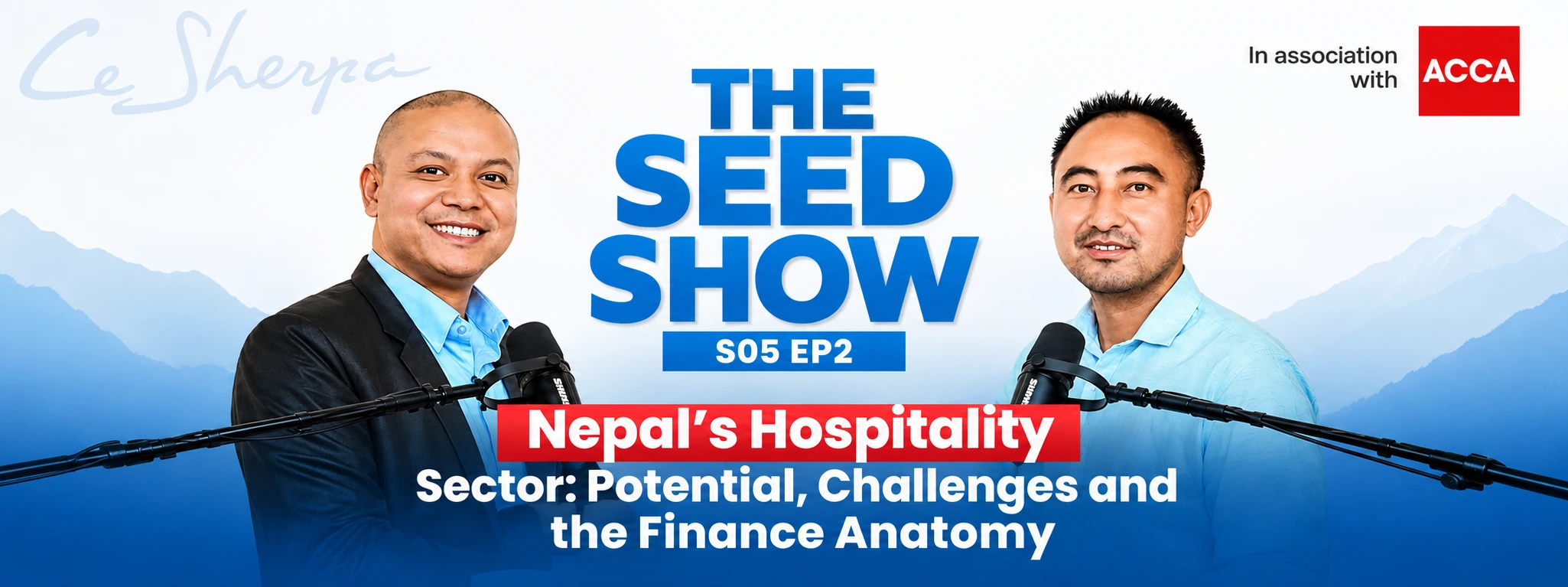

Kathmandu, The Seed Show, produced by Seed Financial Academy in association with ACCA (the Association of Chartered Certified Accountants), continued its fifth season with second episode devoted to one of the least travelled career routes for finance professionals in Nepal: hospitality.
Host Sanjay Pradhan was joined by Sailesh Rai, FCCA, Chief Financial Officer at Le Sherpa Concept and a consultant to the Sherpa Hospitality Group. The two have known each other since 2007, and the conversation ran for just over an hour across career advice, sector economics, hotel finance fundamentals and a set of policy recommendations aimed squarely at regulators.
As Mr. Pradhan noted in his introduction, Season 5 was designed to bring ACCA members and affiliates on air from across industries. Hospitality proved one of the harder sectors in which to find one.
A career built across audit, Dubai and hotels
Mr. Rai qualified first as a Certified Accounting Technician (CAT) member in 2010, a route that then required clearing nine to ten papers, including taxation before completing the ACCA qualification in 2014. His professional journey began in parallel, with an audit articleship around 2010–11.
That early audit exposure was unusually broad. His portfolio included hotels, the airline and aviation sector, card service providers at a time when Mastercard and Visa had barely arrived in Nepal, trading companies, hospitals and INGOs. A period in Dubai followed, adding international experience, before he returned to Nepal in 2018.
His first full-time role in hospitality finance was with the Dwarika’s Group. From there he moved to Sherpa Hospitality Group as Group Finance Controller, then to a corporate role heading hospitality finance and mergers and acquisitions, followed by a stint at Dusit Thani, the international five-star luxury property. He has now returned to what he calls his home ground, Sherpa Hospitality Group as CFO of Le Sherpa Concept.
Away from the balance sheet, he reads, invests in the stock market with an eye on portfolio diversification, and plays guitar when time allows.
Why ACCA: “It kind of happened to me”
Asked how ACCA clicked, Mr. Rai was candid that it was not a childhood plan. After completing his 10+2 at Prasadi Academy with a strong commerce grounding, he was looking for a route into the accounting profession, and several professional bodies offered comparable platforms.
What made ACCA stand out for him were three things: practical application in real work, global presence, and the qualification’s ability to adapt with the times – reinforced, he added, by continuing professional development (CPD) requirements that keep working professionals current.
He is equally direct about the difficulty. At the time there were very few colleges offering the qualification in Nepal and a genuine shortage of good lecturers. There were textbooks read until midnight and sleepless nights before exams.
There were also, he confirmed when Mr. Pradhan raised the question, moments that tested him. Despite scoring 70–80 per cent in his CAT papers and moving smoothly through the fundamentals and skills levels, he got stuck on of all things the audit paper, while working as an auditor.
What carried him through, in his own framing, were two words:
“Perseverance and consistency.”
Consistent study, consistent time allocation and a workable balance between personal life and study managed alongside a full-time articleship were, he said, what finally got him across the line.
What the qualification gave him in return was a language: the language of business, of finance, of business decisions and investment decisions. After qualifying, it allowed him to apply that language across a much broader set of stakeholder relationships, internally within the group, and externally with banks, investment committees and board members.
Why hospitality? A calculated bet on Nepal
Mr. Pradhan put the question that many students will recognise: trainees overwhelmingly gravitate towards audit firms, outsourcing, banking, insurance or energy. Hospitality is rarely on the list. So, in the case of Mr. Rai, was this deliberate, or did it find him?
Partly both, was the answer. The hotel audits early in his career planted the seed. But the decision to commit came after Dubai, an economy that runs largely on tourism rather than oil, and that has built the infrastructure to support it.
Returning to Nepal in 2018, he saw a country with religious and cultural diversity, natural diversity, lakes, mountains, flora and fauna; and a tourism sector contributing only around 2 to 3 per cent of GDP. By 2025, he estimates that figure has risen to roughly 6 to 7 per cent, alongside a substantial share of the country’s foreign exchange earnings. For comparison, he pointed to Thailand at somewhere around 11 to 12 per cent.
His conclusion: the potential is immense, and the sector needs finance professionals capable of giving the right interpretation to its numbers.
Mr. Rai mentioned that it kind of partially happened to him, but it was the best decision he could have taken. At that point of time it was the best decision, and it still is.
Inside Le Sherpa Concept
For viewers unfamiliar with the structure, Mr. Rai explained it plainly. Sherpa Hospitality Group is a hotels, restaurants and travel services group associated with Yeti World, spanning hotels, resorts, travel and trekking. Le Sherpa Concept is its food and beverage wing.
That wing is larger than the label suggests. It includes Nomad Hotel Kathmandu and Nomad Hotel Pokhara Lakeside; the Le Sherpa Farmers Market; MTR, the South Indian restaurant, in Kathmandu and Mustang; an Italian restaurant; La Casita, a Spanish restaurant in Boudha; and Farm Shop, a retail operation selling directly from farmer to customer.
His CFO mandate covers strategic decision-making, financing and advisory work, with operational support where it is needed. His separate consulting engagement with Sherpa Hospitality Group sits further from day-to-day operations and closer to mergers and acquisitions, fundraising and financing, working closely with the CEO.
Planning around the weather
Mr. Pradhan pressed on the sector’s defining vulnerability: performance tied to weather, seasons and festival calendars.
Mr. Rai’s response was that this is part and parcel of doing business and, in fact, the part that fascinates him.
“The beauty of managing finance in hospitality is planning the uncertainty.”
The mechanism is straightforward in principle and demanding in practice. Roughly six to seven months constitute the season, with five to six off-season months. Profit generated during the season months finances operations during the lean ones.
The group also hedges through geography and guest mix. Some F&B outlets trade throughout the year; some hotels operate eight to ten months. Peak periods cluster around September to November and April to May for international arrivals, while domestic tourism and properties spread across different terrains: a Chitwan resort, a Japanese hotel in Lumbini, high-altitude Mustang smooth the curve further.
On challenges more broadly, he named three:
- Connectivity and infrastructure. Road access to many destinations remains inadequate, and logistics costs are severe. For high-altitude lodges, porter logistics alone can account for a significant share of F&B cost.
- Supply. A large number of international brands and legacy hotels are competing for the same guests.
- Political stability, which he called super important and outside anyone’s control.
Asked how the roads were on a recent trip, Mr. Pradhan’s answer drew laughter: look at my vehicle.
The three numbers before the first coffee
One of the most practically useful stretches of the episode came when Mr. Pradhan asked what a hospitality CFO looks at first thing each morning.
The daily ritual: occupancy, ADR, and the forecast for the next 7 to 14 days. The underlying data arrives automatically from the night audit conducted around 1 a.m., with the income auditor and night auditor circulating what the industry calls a manager’s report or flash report, checked by both front office and finance.
Layered on top is a rolling cash flow forecast, refreshed weekly or every 14 to 15 days. As Mr. Pradhan observed, the cash flow forecast is a comprehensive interpretation of everything else.
For viewers outside the sector, Mr. Rai walked through the terminology:
Occupancy is not one number but several. In a 100-key hotel with 70 rooms sold, occupancy is 70 per cent. But if only 60 of those rooms were actually paid for, paid occupancy is 60 percent, with the remaining ten accounted for by in-house or complimentary use. Cash forecasting works off paid occupancy.
ADR is the average daily room rate. If a booking channel sells a room at USD 100 on a bed-and breakfast basis, and breakfast is allocated at USD 10 to 15 to the F&B revenue centre, the room revenue is USD 85 to 90. ADR itself is calculated across the day: total room revenue divided by rooms sold.
Beyond those, he watches flow-through and incremental contribution margin and makes a point of saying he does not chase occupancy or ADR in isolation.
That distinction matters competitively. If a comparable hotel drops its rate from 10,000 to 8,000, the CFO’s job is not to reflexively match it, but to diagnose it: is this seasonality, or a new entrant buying market share? Which segments are involved: OTA channels, travel agents, corporate accounts and what contribution margin does each deliver? Often the better answer is to add value rather than cut price: a visa arrangement, or a complimentary airport pick-up for direct website bookings.
On the human element of all this, he was unambiguous. Working with the CEO, the chief marketing officer or the commercial director, options A, B and C each produce different outcomes.
“The most important thing is judgment.”
Farmers Market: brand and margin
Mr. Pradhan asked whether Le Sherpa Farmers Market, one of the pioneers of the format in Nepal, pays for itself or simply builds the brand.
It does both, Mr. Rai said. It is a form of backward integration and a sustainable partnership: farmers showcase products directly to guests rather than surrendering margin to wholesalers in the supply chain. Some of those stakeholder relationships now run five to ten years.
Talent: the retention question
On the sector’s manpower gap, Mr. Rai cited a service output in the hundreds of billions of rupees and a workforce in the hundreds of thousands, describing hospitality as a growing rather than booming sector.
The real issue, he argued, is not recruitment but retention. With international brands entering and legacy hotels expanding, turnover is a constant. But he pushed back on the assumption that people leave purely for money. What determines whether staff stay, in his view, is whether the organisation has offered a genuine career development platform, and whether its values, culture and leadership style are ones people want to remain within.
He offered himself as evidence, having returned to the group he had previously left.
Summary of discussion for students considering the field:
“If someone has the right skill set, there is still a lot of space and a lot of opportunity in this industry to make a career in.”
Rapid fire
- Food or hospitality? Both but if forced to choose, service.
- In a bad month, rooms or F&B? F&B, because non-resident guests will still come to the restaurants even when rooms sit empty.
- One place, eyes closed? Mustang the terrain, the landscape and the culture it carries.
- Audit a hotel or run a hotel? Run a hotel. Audit is sceptical by nature; running one demands an entrepreneurial mindset, risk-taking and managing uncertainty.
- ACCA in one word? He couldn’t manage one offering instead a comprehensive finance qualification spanning investment, audit and taxation, and above all, practical application.
Five minutes with the policymakers
Given an open brief to address the tourism board, the central bank and the tax authorities, Mr. Rai raised three points:
Infrastructure and connectivity. Logistics constraints and access to remote destinations are, he argued, a direct reason large international hotel brands have hesitated to invest in Nepal.
Financing models. He was frank that lending in Nepal remains predominantly collateral-based rather than assessed on business upside or value proposition which is a mismatch for a sector whose returns are built on operating performance.
Taxation and payback horizons. Hospitality is capital intensive with a long payback period, and he suggested policy should reflect that reality.
Looking to 2035
Asked where the sector sits a decade from now, his answer was unhesitating: phenomenal potential, and a credible path to becoming one of the top four contributors to national GDP.
His reasoning rests on the trajectory already visible: growth from roughly 2 to 3 per cent of GDP in 2018 to 6 to 7 percent today, achieved despite the pandemic, geopolitical disruption and domestic instability. A twofold or threefold increase from here, he suggested, is not fanciful, provided investment continues and government support is there.
Mr. Rai and Mr. Pradhan closed on a shared point about local sourcing: with substantial imports currently feeding the sector, initiatives like the Farmers Market do more than support farmers. They help the balance of payments.
Closing note
Wrapping up, Mr.Pradhan thanked Mr. Rai for a conversation he described as a genuine learning experience and said he would encourage anyone interested to consider a career in hospitality.
Mr. Rai, in turn, thanked Seed Financial Academy and ACCA for the platform, and closed with an appeal to viewers to watch, share feedback, suggest guests for future episodes, and subscribe to the channel.
The Seed Show is produced by Seed Financial Academy in association with ACCA. New episodes of Season 5 feature ACCA members and affiliates from across industries banking, insurance, energy, manufacturing, hospitality and more. Watch the full episode on our channel, and let us know who you would like to see next.