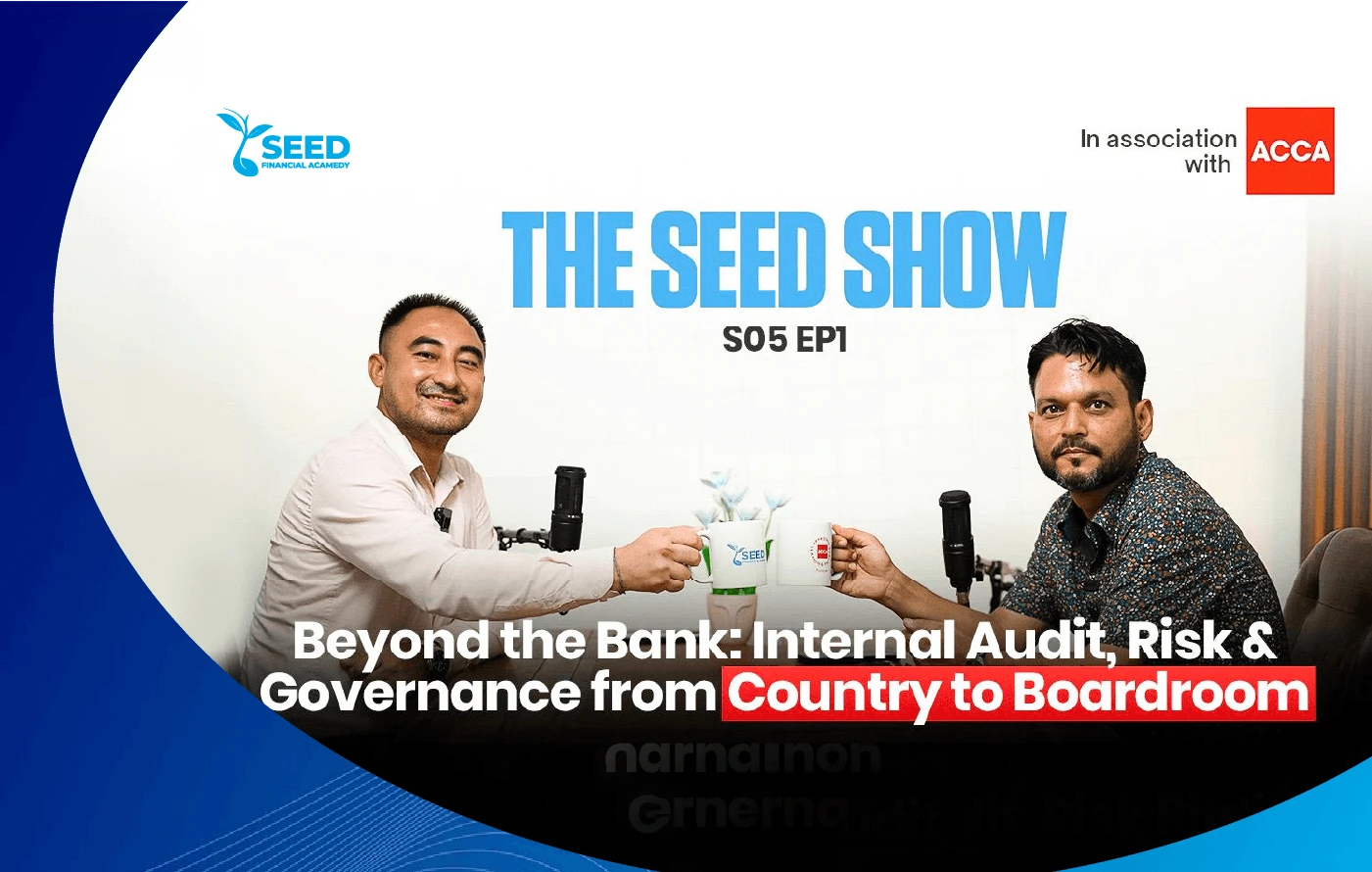

Season 5 Episode 1 of The Seed Show opens with a candid conversation on failure, ethics, and why governance has to start at the top.
The Seed Show is back for its fifth season, and it opens with a guest who spends an hour dismantling the idea that a career in audit is about ticking boxes.
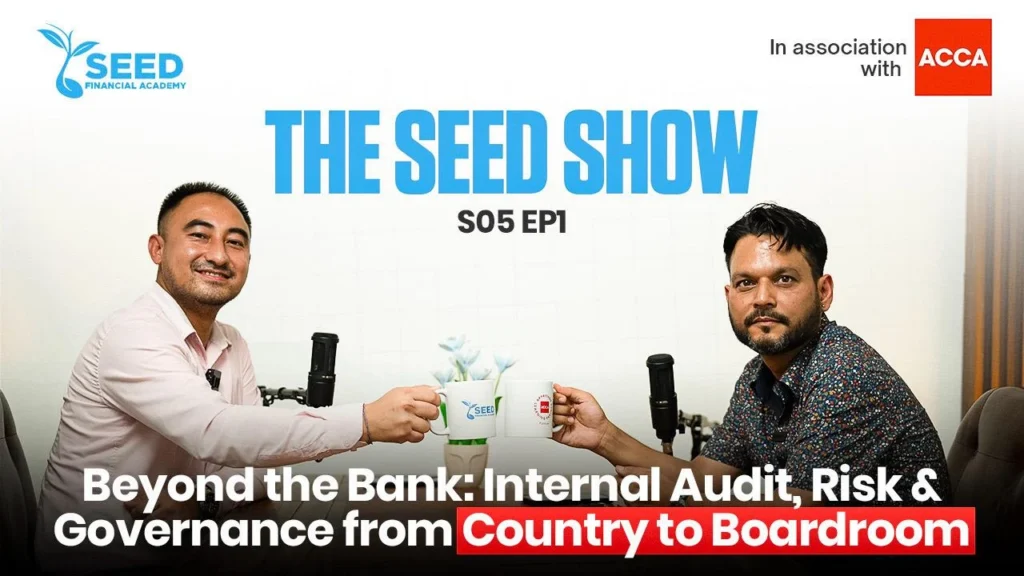
Host Sanjay Pradhan, a fellow ACCA member, is joined by Amar Dhungel, Manager, Internal Audit at NMB Bank, whose career spans close to two decades across audit firms, development sectors, and half a dozen banks. The two have known each other for a long time and first met through an ACCA tuition provider. So the episode feels like a catch-up between colleagues rather than a formal interview.
The podcast covers a wide range of topics, from personal journey to concepts of risk-based auditing. Two talks about exam failures, career transitions, corporate governance, and the concepts of risk-based auditing.
A professional introduction that starts at home
When asked to introduce himself, he didn’t start with his professional identity. He described himself as a good father, a good husband, and a good son, with a proud smile. He mentioned he has been in the banking sector since 2008. Now he is a member of ACCA and Manager of Internal Audit at NMB Bank.
Choosing ACCA, and being honest about why
What might seem to be the generic question of why he chose ACCA over CA is the major dilemma for aspirants. Dhungel frankly replied that he did not have the confidence to clear ICAI within two attempts at the time, when failing twice meant restarting from the foundation level. He also admits he was at an age when friends and distractions had a major impact.
He later followed the suggestion given by his cousin. During that time, his cousin was a chartered accountant who had joined Standard Chartered as a senior manager straight after qualifying. When he asked to explain the difference between the two qualifications, the cousin offered a family analogy: one is the son of the elder uncle, the other the son of the younger uncle. Same family, different house.
The failures students rarely hear about
For students, one of the most relatable parts of the episode is when Dhungel opens up about the setbacks and challenges he faced along the way. Every student faces some kinds of hardships along the way. Students can learn from his experience.
He failed P7 (Advanced Audit and Assurance), a paper he expected to clear comfortably, and concluded that his gap was in accounting standards rather than audit technique.
The host also added further with a conclusion for students: people are intelligent differently, but without effort, intelligence doesn’t work alone. Hard work and perseverance are not extras layered on top of ability; they are what makes ability count.
Both host and guest also touch on a pressure that rarely gets named. Mr. Pradhan shared that he always topped his class from grade one to ten. When he came second once, he found it deeply demoralising. He wasn’t ashamed of his mark itself but of what people will view him as. Dhungel agrees, noting that academically strong students carry an invisible weight.
Balancing articleship, tuition and exams
Dhungel completed his course while also working, and students constantly asked him how he managed to do it. His schedule ran from MBS classes and finance tuition in the morning, to articleship at CSC & Company from nine to six, and another tuition session in the evening.
What made it survivable was ritual. Every six months on results day, the firm threw a party -three people might pass, but ten would be celebrated, and half a year’s salary could disappear in an evening. He now tells juniors to work with the energy they felt on the day they qualified. That first-day pride, he suggests, is a renewable resource.
The transfer that felt like a demotion
After five years at CSC & Company, including 56 days in Hetauda auditing Unilever’s manufacturing operation, alongside development-sector work with Lutheran organisations, the Nepal Red Cross Society and USAID, Dhungel led internal audit teams at Siddhartha Bank, Bank of Asia and Sanima before he entered NMB.
After working for two years, Dhungel was moved to corporate credit, where he handled loans/businesses worth more than NPR 250 million.
When the promotion period arrived, he expected to be promoted, but he wasn’t. That disappointed him. He then spoke to the CEO about it. The CEO told him that corporate credit was a highly sought-after position. Even influential ministers sometimes called the bank to get their children placed in that department. Instead of seeing his placement there as a failure to get promoted, the CEO wanted him to understand that he had earned the position through his own ability and performance.
He stayed and spent six months learning. His verdict on those two years is the episode’s most quotable line: promotion is something that comes and goes, but learning stays. What he gained was Knowledge of Business, the thing he believes auditors most often lack. An audit finding may be technically correct, he says, but the context has to fit, and knowing the business is how you get the context.
Governance: the spirit, not the wording
The heart of the episode is governance, and Dhungel’s translation of sushasan (सुशासन) is a good one: governance that comes from within. He argues that everything can’t be written into a rule-shaped document.
His clearest example comes from a relationship manager’s phone call. Bank directives may stop a senior official, such as a CEO, from taking an overdraft at another bank. But what about the CEO’s spouse?
Compliance may say yes; governance says no.
For Dhungel, this gap is where many institutional failures begin. People may not break the law directly, but they find ways around it. For example, someone may put money in a family member’s name to avoid a restriction, or take part in a decision involving someone they know personally. He contrasts this with an official who, after discovering that his brother was a candidate for a selection committee, chose to resign. That is governance in practice, requiring nothing more than the willingness to do what is right.
Dhungel is equally clear that individual virtue alone is not enough. Recalling his own attempt at entrepreneurship, he describes going to the company registration office with complete paperwork, only to be repeatedly told to return another day. Eventually, someone told him that a small payment would solve the problem. Facing a contract deadline, he paid. He does not use the story to excuse himself and accepts that both giving and taking are wrong. His point is that individual governance cannot outrun the ecosystem. Unless the environment changes, doing the right thing can become an expensive personal choice.
Still, Dhungel is cautiously optimistic about the current push for good governance and merit-based appointments. He also proposes that Nepal needs a genuine whistleblowing policy, backed by a body accountable for regulating it.
Why governance is always top-down
Governance in a bank, Mr. Pradhan argues, starts at the top. When the board acts ethically, follows good governance and puts the institution first, that approach flows down through committees, departments and the executive level. But without independent oversight, governance struggles to reach the rest of the organisation.
For example, the audit committee should oversee internal audit, while a separate risk management committee should oversee risk. This is also why internal audit works from the top down, rather than the other way around.
Mr. Dhungel says corporate governance is not simply about ticking compliance boxes. It is about balancing the interests of everyone connected to the bank: depositors, borrowers, employees, vendors, the government and shareholders. A bank cannot simply collect deposits and refuse to lend. Depositors may be happy, but profits, dividends, taxes and wider economic activity would suffer. Good governance, he says, is about keeping all these interests in balance.
Three ideas on better internal audit
Find the root cause, not the symptom. If a place is dirty, the recommendation is not “It shouldn’t be dirty.” Ask why. If the dirt comes in because there is no doormat at the entrance, the recommendation is a doormat. At NMB, Mr Dhungel mentions he has begun asking for the root cause in audit comments.
Understand the borrower’s situation. Audit should look beyond the numbers and understand what is happening with the borrower’s business and personal circumstances. For example, if a loan payment is delayed by a month because the borrower had to pay for his mother’s surgery, simply flagging the delay as a problem may miss the real situation. Understanding the borrower’s circumstances helps auditors make a fairer and more accurate assessment.
Make recommendations productive. When a recovery management committee meeting was taking up the time of ten people because everyone maintained separate files that later had to be combined into a spreadsheet, Mr. Dhungel did not simply point out the problem. He suggested a practical solution: the relationship manager records the status, the recovery team adds its update, and the MIS generates the final snapshot automatically.
He also mentions that he has started giving the CEO a summary of audit findings instead of expecting him to read the entire report. It is a small but practical approach that makes sure important findings are understood while keeping the working relationship positive.
Even the language used in the profession has changed, he notes. Auditors were once described as watchdogs; today, the term bloodhound is increasingly used. The idea is that auditors should do more than watch for problems-they should actively sniff out where risks are concentrated and investigate them. That requires scepticism, curiosity and a willingness to ask questions.
An honest assessment of risk-based audit
Dhungel is refreshingly honest about the limitations of risk-based audit.
Nepal Rastra Bank moved from the older CAMELS-style framework to risk-based supervision around 2021, and risk-based internal audit has now become standard industry practice. At NMB, auditable units are placed into five risk categories instead of the usual three, and the categories are approved by the board. Management also has to agree that an area is high risk, rather than leaving that judgement to audit alone.
His view is straightforward: risk-based audit is a good concept, but in practice, it is mostly used for planning. It is easy to say an audit is risk-based, while subjectivity remains part of the process, no matter how objective the criteria appear. He would rather call it risk-based planning, because a truly risk-based audit should also involve risk-based sampling. His audit committee chose a blended approach, which he believes is more practical.
He also points out a risk in focusing only on high-risk areas. If a branch is completely left out, it could be the same branch where fraud occurs or a regulatory issue emerges. Simply knowing that an audit may take place, he notes, can itself act as a preventive control.
Technology has helped reduce this gap. With most information available through the operations MIS and loan origination system, much of the work can now be done through desktop audits. This allows a team of seventeen to cover around 160 branches. When NRB raised concerns about repeated findings, the team extracted data from the MIS and followed up with branches until those recurring issues were resolved.
Governance in practice at NMB
Asked about concrete initiatives, Dhungel’s first answer is surprisingly simple: the board does not interfere.
Beyond that, he points to full compliance with NRB’s corporate governance directives and the adoption of Basel Committee guidance wherever it fits the Nepali context. He mentioned that not everything has been adopted, citing the recommendation that CRO, CFO and internal audit heads should receive fixed pay without profit-linked bonuses. He also mentions compliance with IMF and World Bank loan covenants, along with seven or eight governance policies covering related-party transactions, conflicts of interest, anti-bribery and corruption, whistleblowing and compliance.
On transparency and disclosure, what he calls another key pillar of governance, and one Nepal talks about the least, the bank publishes its organisational structure, policies, and directors’ qualifications and experience on its website. He also notes with some satisfaction that the bank’s Dutch shareholder conducted a board evaluation two years ago, something he believes only one other bank in Nepal has done.
Rapid fire
- One ACCA paper you’d sit again? P7 — he is still annoyed about failing it.
- Onsite or offsite audit? Offsite.
- The NRB inspection team arrives tomorrow -what’s the office vibe? Bad. Though he stays calm.
- One resource every finance professional should read? The P7 learning material.
- One word for the ACCA journey? A fine and beautiful journey.
Closing advice: follow the interest
For students choosing between an INGO offer and a bank’s internal audit team, Dhungel’s advice is simple: start with what interests you. He says he is raising his own son the same way. He does not need another chartered accountant or doctor in the family, and if his son wants to open a grocery shop, he should be free to follow that interest. Make your interest your hobby.
Mr. Pradhan adds that interest alone is not enough. You also need clarity about the sector. While studying, students should learn about the field they want to enter and understand the skills it requires. Building yourself for that career takes time.
Both agree on the larger point: if you have no interest in the field you choose, it is difficult to survive in it, both technically and emotionally.
The takeaway
When asked near the end what matters most, Mr. Pradhan gives an answer that applies equally to a person, a bank and a country: the first step is accepting that something is wrong. Only then can you start thinking about what needs to change.
He is careful to say this is not about self-praise. Looking at recent enforcement actions against banks, he argues that the underlying problem almost always comes back to governance. An institution may have a capable internal audit team and strong risk management, but without good governance, neither can function effectively.